Showing posts with label Vishnu. Show all posts

Tuesday, May 6, 2014

DIFFERENCE BETWEEN KALYUG & OTHER YUGA (Satyuga, Tretayuga or Dwapar yuga)


Yuga, the word itself signifies the Ages, which is used to describe in the Indian History. India, or say Bharat, the rich and fertile country with deep knowledge of Vedas, Purans and Updesh like Gita flourished the people throughout the ages.

Yugas are divided in 4, termed as:-
1.) Sat Yuga (Golden Age)
2.) Treta Yuga (Silver Age)
3.) Dwapar Yuga (Bronze Age)
4.) Kal Yuga (Iron Age)


Satyuga, the very 1st yuga as per Hinduism which is also known as the best yuga and often called as Golden age in the history. It consists of purest part of the Varna i.e. Brahmin, which themselves are satisfied and were far away from the materialistic world. Knowledge, meditation, humanity and penance were present in this yuga. 

Lord Vishnu incarnated 4 times in this era which are Matsya, Kurma, Varaha & Narsimha. Sat Yuga lasted for 17,28,000 years and average human lifespan was 100,000 years.

Treta Yuga, is the 2nd out of four yugas which is also known as Silver age in the religion of Hinduism. The Varna associated with this era is Kshatriyas. The most famous events of this yuga were Lord Vishnu's fifth, sixth and seventh incarnations as Vamana, Parashurama and Rama respectively. 

The Treta Yuga lasted 12,96,000 years and average human life span was around 10,000 years.

Dwapar Yuga, is the third out of four yugas as described in the ancient scriptures of Hinduism. Dwapar yuga comes after Treta Yuga and before the dark Kali Yuga. The Varna associated with this era is Vaishyas. It is stated in the Puranas that this yuga ended when Krishna returned to his eternal abode of Vaikuntha. 

Two major incarnation of Lord Vishnu in this era are Krishna & Gautam Buddha. According to the Bhagavata Purana, this yug lasts for 8,64,000 years and average life span reduced to 1,000 years.

Kali Yuga, the darkest of all the ages and called as Iron Age in which the quality of persons / people residing in that age deteriorates with respect to the time. Yugas has passed and now we are in the phase of Kalyuga which is considered as the lowest of all the Yugas. The Dharam Bull, which symbolises morality, stood on all the four legs in Sat Yuga, three legs during Treta Yuga and two in the later Dvapara Yuga. Currently, in the immoral age of Kali yuga, it stands on one leg. 

The varna associated with this era is Shudra. The overall duration of Kali Yuga is around 4,32,000 years and the average life span of an individual is 100 years, which will further reduces to 20 years at the end of the yuga.

Lord Vishnu’s 10th Avatar named as Kalki will take place in this period. He shall be the one who destroys the Kaliyuga and reinitiate the holy and divine Satya yuga. And later on worshipped by the whole world.

Sunday, March 16, 2014

THE THREE GUNAS - RAJO, SATVA & TAMO


Gunas are attributes, qualities which define the character of the individual.

Tamo Gunas are the lowest form of Gunas that arise from the desires and greed of the mind. It showers inertia, selfishness, shrewdness troubling others and keeping everything without progress.

Rajo Gunas involve intellect and need a conscious mind to perform them. It signifies ego, bravery, jealousy, wars, struggles and helping with a motive.

Satva Gunas are entirely spiritual and are based on wisdom, consciousness and awareness of the being. It is the light, the purity, the kindness charity and compassion.

Briefly, Gunas have the following characteristics:-

1.) Satva Guna - Illuminating.
2.) Rajo Guna - Activating.
3.) Tamo Guna - Restraining

When there is Disbalance of these Gunas, the Universe comes into existence. Each and every individual has to control / balance their level of Gunas.

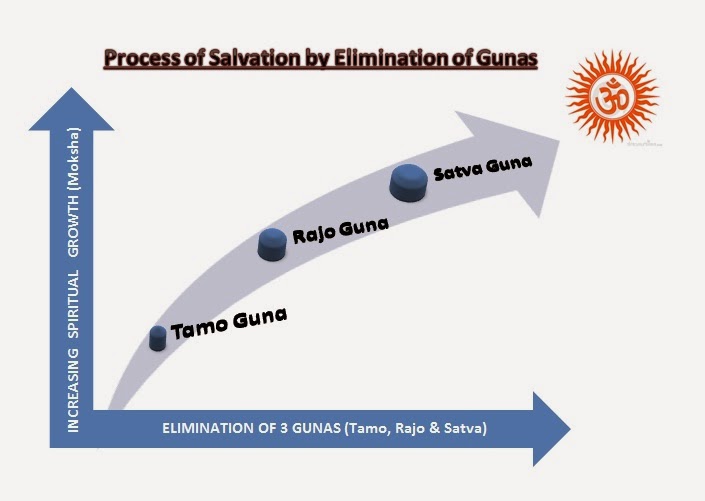
1.     First, control the lowest one i.e. Rajo Guna, as it reduces the speed of progress of an individual’s growth. This Guna can be control only by the proper use of other 2 Gunas viz. Rajo Gunas & Satva Gunas.

2.   Secondly, after eliminating the Tamo Guna, hit on the Rajo Gun, as it also decelerates the person’s spiritual growth and sometimes helps Rajo Guna to exaggerate.  Only Satva Guna has the power to eradicate this Gunas.

3.    Finally, try to leave the Satva Gunas also, as it take the person soul near to the God, but does not permits to dissolve in it. So, leaving Satva Guna is also very important in everyone’s life.

The one who exterminate these 3 types of Gunas, gets enlightened and reaches the final destination (God’s Feet) and attains Salvation (Moksha)


Friday, March 14, 2014

BIRTH OF UNIVERSE


As per our Hindu Mythology, the 3 main deities which are responsible for Birth (Creation), Upbringing (Preservation) and finally Death (Destroy) are The Brahma, Vishnu & Mahesh (Kaal Rudra).

As stated in earlier blog,

BRAHMA:                “The Creator of the Universe”
VISHNU:                   “The Protector of the Universe”
KAAL RUDRA:         “The Destroyer”

The whole universe is shaped by the Lord Brahma and he is honored by the name as “The Creator”. However, Lord Shiva is considered to be the topmost of all the three gods.


For successfully driving the cycle of whole Universe, when Shiva (The Supreme God) associated with Rajo Guna, he acts as Brahma (Creates Universe). Further when associated with Satva Gun, he acts as Vishnu (Preserves Universe) and subsequently when linked with Tamo Guna, he acts as Kaal Rudra (Destroys Universe).


Birth of Brahma, Vishnu & Rudra


In short, we can say that, Lord Shiva behave like a SEED, which yields different products when preserved at different atmosphere (Rajo, Satva & Tamo Gunas).


Lord Shiva is the topmost Deity of all the Gods, he is called as Aadi (start) as well as Aant (end). He is the one who Creates first, then Protects and then finally Destroys. He is the most eminent among all the Gods.

In Brief:-

SHIVA IS BRAHMA, SHIVA IS VISHNU & SHIVA IS KAAL RUDRA.


Saturday, March 8, 2014

THE 18 PRIMARY PURANAS


LORD VISHNU is the Predominating Deity of the following Six (6) Puranas:

Bhagavata Purana has 18,000 verses, and is a jewel of the Vedas, providing all instruction on the science of self-realization.

Vishnu Purana has 23,000 verses, including stories of various devotees, a description of varnasrama, the six angas of the Veda, a description of the age of Kali, a description of Sveta Varaha Kalpa, and Visnu dharmotara.

Narada Purana has 25,000 verses, and contains a synopsis of the complete philosophy. It describes Jagannatha Puri, Dwaraka, Badrinatha, and other holy sites.

Padma Purana has 55,000 verses, and contains the glory of Srimad-Bhagavatam, and stories of Rama, Jagannatha, Matsya, Ekadasi, Bhrgu, and others.

Garuda Purana has 19,000 verses, and discuss the subject of Bhagavad-gita, reincarnation, visnu-sahaasra-nama, and a description of Tarsya Kalpa.

Varaha Purana has 24,000 verses, and describes the different vratas and Lord Visnu's glories.


LORD BRAHMA is the Predominating Deity of the following Six (6) Puranas:

Brahmanda Purana has 12,000 verses, and describes the vedangas and the Adi Kalpa.

Brahmavaivarta Purana has 18,000 verses, and describes the glories and pastimes of Sri Sri Radha-Krsna.

Markandeya Purana has 9,000 verses, and tells the stories of Rama and Krsna.

Bhavisya Purana has 14,500 verses, and describes the glories of devotional service to Sri Krsna, along with the prediction of Lord Caitanya.

Vamana Purana contains 10,000 verses, and tells the story of Lord Trivikrama.

Brahma Purana has 10,000 verses, and describes the teachings of Lord Brahma to Daksa.


LORD SHIVA (Rudra) is the Predominating Deity of the following Six (6) Puranas:

Matsya Purana has 14,000 verses, and describes the Vamana and Varaha Kalpas, and temple construction.

Kurma Purana has 17,000 verses, and describes the conversation between Krsna and the Sun-god, Dhanvantari, and the Laksmi Kalpa.

Linga Purana has 11,000 verses, and describes the glories of Lord Nrsmhadeva, the stories of Janardhana and Ambarisa, and the glories of Gayatri.

Shiva Purana has 24,000 verses, divided into six samhitas. It was recited by Vedavyasa’s disciple Romaharshana.

Skanda Purana has 81,100 verses, and describes the slaughter of the demon Tarakdsura by Skanda (Subrahmanya). Skanda Purana is very similar to the Kumarasambhava of Kalidasa.

Agni Purana has 15,400 verses, and describes Salagrama and the Isana Kalpa.

Copied from: www.harekrsna.com

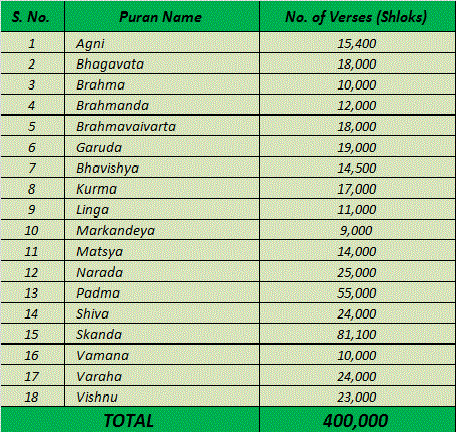
NUMBER OF VERSES IN 18 DIFFERENT PURANS


WHAT ARE PURANAS?

The Puranas have the essence of the Vedas, and written to popularize the thoughts contained in the Vedas. They were meant, not for the scholars, but for the Ordinary People who could hardly fathom the high philosophy of the Vedas.


Copied from: en.wikipedia.org

BRIEF HISTORY OF PURANS


As per Hindu Mythology,

The 3 basic gods which started the life cycle on this planet or say universe are, The Brahma, The Vishnu & The Mahesh (Rudra). Each has different powers to run the system properly throughout its span.

LORD BRAHMA: Brahmaji, “The Creator of the Universe”, who construct the universe and harvested life in it.

LORD VISHNU: Vishnuji, “The Protector of the Universe”, who protects the universe and living beings by providing them the things as per their needs.

LORD RUDRA: Kaal Rudra (Sometimes also called as Shivji), “The Destroyer”, who destroys the universe and its inhabitants in the end.

Now as per Ling Puran, Lord Brahma, the inventor of the universe, designed / created PURAN, so that it builds the base of the society which further directs the individual to their basic means of life. Purans are the books of Hindu legends and contains religious instructions. Puran narrates the history of the universe from creation to destruction, role of kings, heroes, sages, and demigods, and descriptions of Hindu philosophy.

Lord Brahma written the Puran consisting of 100 Crores Verses (Shloks), which was further translated by our ancient Saint Ved Vyaas (Maha Rishi Ved Vyaas). He briefly converted those 100 Crores Verses into 4 Lakhs Verses (Shloks) and divided the same into 18 Purans.

LIST OF 18 PURANAS & NUMBERS OF VERSES IN IT